This is Part II of a two part article written by Mat McHugh which first appeared in Fly Angler Magazine in 2008.
Mat McHughs is Director of Fly Odyssey, a UK based company that does what the name implies.
In Part II we see two bonefishing characters we’ve written about previously… in fact, it is the same trip that spawned articles from both Charles Rangeley-Wilson and Peter Morse.
New Caledonia Trophies
Mathew McHugh finds trophy bonefish in New Caledonia.
EXPLORATION OF THE NORTH
That first bonefish encounter infected every pore of my body and over the next year, I spent every holiday opportunity that arose planning trips to bonefish destinations. I was lucky enough to visit some fantastic bonefish fisheries in French Polynesia and Central America. Eighteen months after that first visit I was sitting in a Heathrow Airport cafe trying to answer the questions of Charles Rangeley-Wilson on how many fish we were going to catch and how big these fish would be at the beginning of a 35 hour journey to the north of New Caledonia. I couldn’t honestly say. These questionswere what we were hoping to answer with our trip to the north.
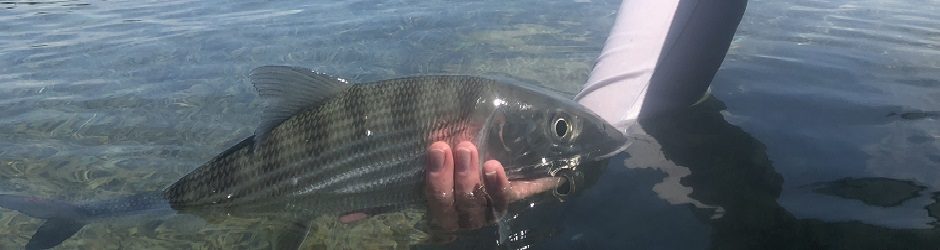
That looks fun!
We met up with Peter Morse in Sydney and then our hosts Richard Bertin and Henri in New Caledonia. Our transfer to the north and the Malabou Beach Hotel by road was the culmination of eight months planning and a bloody long journey. We would spend ten days with Malabou as our base to fish as much of the northern flats as we could. Charles and I were both filled with uncertainty as to what to expect, but Peter’s tales of previous trips and big bones ensured I woke well before sunrise on that first morning, with a rush of anticipation that precedes a day’s fishing in unknown waters.
The coastline of the Northern Province, stretching from Poum on the west coast to Boatpass at the northern most point and down to Phagaan on the east coast, is a plethora of mangrove lined shallow bays, sand flats, coral reef and dozens of small islands scattered about. Looking at a topographical map of the region it is hard to imagine that a lifetime fishing could uncover all its secrets.
The largest islands, Isle Baaba and Isle Balabio, possess some of the most extensive flats I have seen. The reef of Balabio on the lee side of the island extends from the sand cay of St Phalle for over 25 km and is 2 km wide at its narrowest point. Sand has built up on this reef to create a sandflat habitat that takes your breath away when you first approach it and look at the expanse of white that stretches to the horizon where it meets rich, red, bare mountains. This must be one of the most scenic bonefish locations in the world. The St Phalle flats contrast markedly with the shallow mangrove lined bays of Isle Baaba, with the slightly tea stained water providing a colour reminiscent of that found in Ascension Bay and provide extensive feeding areas for the bonefish found here.
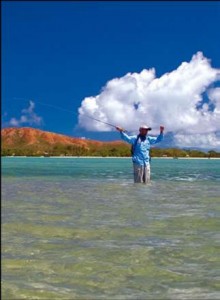
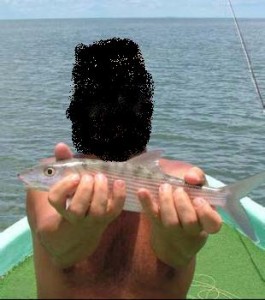
Can you hear the line carrying through the air?
THE FISHING
On our first morning, we approached the easily accessible flats of Boatpass, not really knowing what to expect. Arriving at spring low tide the flat was practically dry and we concentrated on the deep edges. It didn’t take long before we found some bones but they were tough to fool as they cruised the drop-off waiting for the tide to flood in. It was however, a huge confidence boost having travelled all that way to find fish within hours of arriving, given the uncertainty of it all. The afternoon high tide bode well for our chances.
Our host concentrated on blind fishing the deep channel during this low water period and it wasn’t long before he happily showed us what was swimming around these waters. A bonefish that pushed into double figures was a great sight. But we didn’t come here to fish blind. I wanted to see these fish up feeding on the flats, stalking and casting, really bonefishing.
By the end of that first day, I hadn’t landed a fish but had witnessed some fantastic flats fishing for bonefish. As the tide started to run we followed it onto the small flat of Boatpass, and so did the bonefish. The two hour or so burst of activity as the fish came in waves was exactly what bonefishing is about. Except there was one difference to what I had experienced in Mexico, and to a lesser degree in Tahiti. The fish were all big. Not all trophies but the average fish was in excess of 6 lb. A double hook up of a pair of twin fish estimated at 8 lb each was the highlight of the day and the smiles on Charles and Peter’s faces made for a great start.
The real jewels were found on the flats of St Phalle, Ballabio and Baaba. Peter had been gabbing all week about the huge fish that he had previously witnessed at St Phalle and the little queenie that stole his fly from one giant bonefish’s mouth. We were eager to explore, knowing that these flats had been very rarely fished over the previous twelve months.
Our first few days on the St Phalle flats coincided with midday low tides so we would catch the flow of fish off the flats into deeper water in the morning and then the return movement as these fish came back up onto the flats to feed during the flood tide. The short period of activity as the fish flood off and then onto the flats maybe only lasted an hour or two each morning and afternoon, but it was intense fishing. Not intense in the manner of landing huge numbers of fish but intense in respect of being able to hold your nerve and present a fly to these huge bonefish.
We spent the vast majority of our ten days fishing just a small portion of this flat, and if I could nominate just one place to fish my life away, I think this may be it. By the end of the trip we were in the neaps and the bonefish behaviour had altered. We were now encountering larger schools of fish. There was enough water left on top of the flat that the fish would stay longer and feed in the security of a bigger school. It was during the neaps that I witnessed something won’t forget in a long time. With the increased water depth on the emugle during the neap tides, we were now wading knee to mid thigh deep. Sounds of splashes broke the all encompassing silence that is found when wade fishing these flats, and these turned out to be the give-away sounds of tailing bonefish. I’ve been lucky enough to see bonefish tailing in skinny water and there is no better sight, but to have fish tailing in thigh deep water, well that’s just taking the piss.
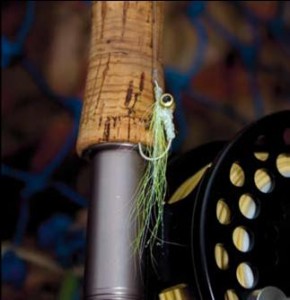
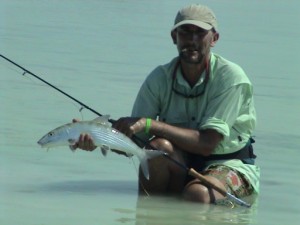
Simple
We caught and landed fish each day. Big fish. Not everyone caught everyday and if I averaged the whole week out I landed one bonefish a day. A one fish day is a good day. My best day was three bones. I lost the same amount again through long releases, reef burn and useless knot tying. So all going well you might expect to land on average two fish a day. What’s so special about that you may say? I can go to Christmas and a large number of other destinations and land a dozen fish a day! What makes this place extra special is not the chance of a shot at a trophy but the guarantee of a shot at one. These fish are genuinely big.
KEYS TO THE FISHERY
The New Caledonian bonefishery is unique. It is at the extremities in terms of latitude when it comes to bonefish distribution, being bisected by the Tropic of Capricorn; theinvisible line marking the geographical limit of the tropics. New Caledonia has been blessed that the local Kanak people are very conservative and extremely protective where their sea wildlife is concerned. Combine this with very low population densities in the north of New Caledonia and you are left with healthy fish populations. Even today, local operators have to work closely with the tribes of the North to obtain permission to fish the region.
TIDES
During our stay we found that tides played a pivotal role in the way the fish behaved, the number of fishable flats available and the duration of your ‘windows of opportunity’. We fished spring tides early in the trip and ended the trip fishing the neaps. During the spring tides, a pattern emerged during the week whereby a window of 1-2 hours, as the fish flood on or off the flat, provided the only chance at bonefish for the session. With middle of the day lows, you would get two shots at them, the runoff in the morning and the flood in the afternoon. Our down time during the low was spent eating lunch and harassing the local spangled emperor and trevally populations. Spring tides also allow access to some of the deep water flats that are unwadable during neap tides. The large southern flats of Balabio, flats that can only be accessed during the big spring tides, were teeming with bones and trevally during the run in and to access those flats again would be the main reason I would plan any trip to New Caledonia to include the spring tides.
The neap tides enabled the fish to stay up on the flats longer and feed and I would imagine during the smallest tidal neaps that they would perhaps stay up on the flats all day. The fish were found in bigger schools during the neap tides. Obviously, the threat of shark, barracuda and giant trevally attacks are more likely with more water on the flats allowing better access for these big predators.
While some deep water flats become inaccessible during the neap tides, some of the shallow water flats can now be fished throughout the tidal cycle. We would find ourselves fishing the top of the tide on a very shallow flat, with bonefish feeding all over the top of it and once the tide had started to fall. Harvey, our guide, would chaperone us to the boat and move us to a flat that would be at the correct depth to intercept fish retreating from the mangroves. The neaps then resulted in a longer window in which to fish.
These northern waters have the advantage of having flats that fish well during both the neap and spring tides, and the instinctive understanding of the local Kanak guides as to which flats fish well during each particular tidal stage ensures that there are flats available to bonefish whenever you visit.
TACKLE
There are several considerations tobe made with respect to tackle when fishing for bonefish in New Caledonia. For rods, a nine weight is probably the perfect tool for these fish. I fished half the week with a 9 weight and half with an 8 weight and preferred the extra control and punch of the bigger rod into the inevitable winds that you will face on these flats, and the extra grunt when it came to finishing the fight.
It goes without saying that a quality drag system is required to land these fish but probably just as important in a reel is the need to cram on as much backing as possible. I don’t know how far these fish run but it is a bloody long way. Between the three of us, we all fished a variety of lines and I would recommend taking not only your standard weight forward floater, but also chuck a sink tip and intermediate into your tackle bag as well. At the business end, 5 feet of 60 lb mono made up the butt of my leader. I then tapered it down to 21 lb fluorocarbon at the tippet, totalling about 9 or 10 feet total length. As always, each fly fisher had a different selection of flies that worked for them. Charles enjoyed success with a variety of dark rabbit fur flies, Peter slayed them with Christmas Island Specials and Gotchas and I had confidencein small chartreuse Clousers and pink or tan Gotchas. I had imagined before my arrival that these fish would eat whatever was thrown at them being such unpressured fish, but as is generally the case, presentation was all important. There were plenty of refusals and even some fish found turning tail at the look of some of the flies I threw at them.
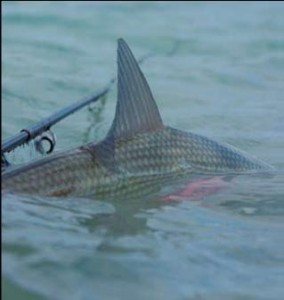
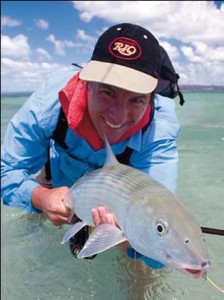
That’s my kind of dorsal.
VISUALLY CHALLENGED
There is one advantage fishing to 26-plus inch bonefish on a bright sunny day and that is that their dark green backs stand out like beacons as they amble along white sandy flats. But there is also one guarantee in bonefishing; that the white, fluffy, cumulus clouds blowing across the skies above your head always meet the sun when you least want them to.
The huge bonefish you had been following disappears with the light and the frustration results in all manner of abuse to the skies. The weather in New Caledonia is fickle and you must expect some frustration with the cloud, but there are a few approaches to overcome cloudy days. The first is to stick on the right hand shoulder of the guide. Their eyes are out of this world and they can spot fish in even the most difficult conditions. The approach that I also found to work well on overcast days was the stake out. Knowing which direction the fish would be approaching, you get yourself a window of about 30 feet in front of you. I made the point of knowing exactly where all the dark patches of weed were in that window and then it is just a matter of staring and waiting for a fish to enter that space. It takes every ounce of patience to stand and wait and there is always the overriding urge to wade, but the stake out turned several overcast, unpromising days into days to remember.
WHAT DOES THE FUTURE HOLD?
It is always difficult to know how these remote fisheries will develop over time. Since New Caledonia was first put onto the map, the original discoverer of the fishery is no longer operating. A second attempt to open up the fishery is under way and Richard Bertin’s operation, while in its infancy, will ensure that anglers get the chance to experience bonefishing in the Northern Province. While the atolls to the south and east of New Caledonia offer bonefishing opportunities, the jewel is the vast northern region where the extensive mangrove system, huge variety of flats habitats, complete lack of human population and large numbers of very big bonefish make a trophy bonefish fishery a reality.
Thanks to Mathew McHugh and Fly Odyssey for use of this article and pictures.